Yes, robots can clean solar panels without a person guiding every pass. The harder question is whether a site has enough dust, height, panel rows, and labor cost to make the machine useful.
- Dry brushes can remove loose dust without a water supply.
- Wheels, tracks, or cables can move a robot across panel surfaces.
- The payback depends on cleaning frequency, travel distance, and service work.
What an automated cleaner has to do
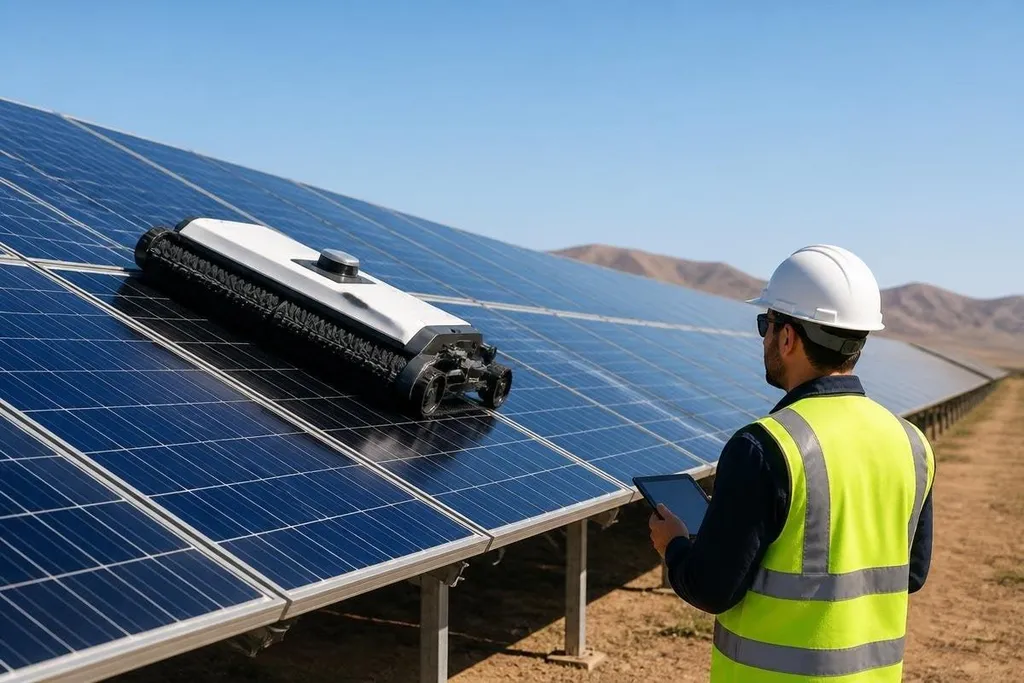
A panel-cleaning robot needs to move across a sloped glass surface while keeping its wheels or brushes in contact with the panel. It also needs to detect the edge, avoid gaps, and return to a safe parking point when its battery runs low.
That calls for more than a motor and a brush. Sensors can help the robot measure its position and detect panel edges, while contact sensors can warn it when a wheel loses grip. A controller then changes speed or direction to keep the cleaning path steady.
The cleaning method matters too. A dry brush can remove loose dust, but it may struggle with dried bird droppings or sticky dirt.
Water can clean more types of dirt, yet a water-fed robot needs tanks, pumps, hoses, or a fixed supply. Those parts add weight and service work.
Where robots make sense
Large solar farms are the clearest fit because a person may need to walk long distances between panel rows. A robot that repeats the same route can reduce that walking and keep cleaning work away from electrical equipment.
Panel layout still decides the result. Rows with consistent spacing and gentle slopes are easier for a robot to handle than roofs with different heights, narrow access paths, or panels split across several buildings. A machine built for one layout may need new software or hardware at the next site.
Dry regions can create a stronger reason to automate. Dust can block part of the light reaching a panel, so cleaning may help the array produce more electricity. The gain will vary with local dust, weather, panel angle, and the time between cleaning runs.
Rows of panels leave little room for a robot to turn, while dust, heat, and loose cables can stop a cleaning run. Solar panel cleaning robotics coverage can show the machine, panel layout, and test setting before the article turns to physical limits.
The limits are physical
A robot on a panel has little room for error. A wheel that slips can scratch glass, break a panel, or send the machine over an edge. Strong wind, rain, ice, and heat can also change how well the robot holds its path.
Water creates another limit. Some sites need water brought in by truck, while others already have a supply near the panels. A dry system avoids that need, but its brush must pick up dirt without wearing the glass or leaving grit behind.
The machine also needs a recovery plan. If it stops halfway through a row, a worker must reach it. That may require a lift, roof access, or a manual release. Any labor saved during cleaning can disappear if recovery takes too long.
No evidence pack here supports a current product price, cleaning rate, or payback period. Those figures need a named machine, a site layout, and measured output before you can trust them.
Check the site before buying
A short site survey should answer these points before a trial begins:
- Panel layout: Record slopes, row gaps, edges, obstacles, and changes in height.
- Dirt type: Check whether the main problem is loose dust, mud, salt, pollen, or dried deposits.
- Power access: Confirm where the robot will charge and how far it must travel between rows.
- Water plan: Decide if the machine will clean dry or draw from a tank, hose, or fixed line.
- Recovery work: Set a safe method for removing a stalled robot without walking on fragile panels.
- Proof of gain: Compare energy output before and after cleaning under similar weather conditions.
I’d choose an automated cleaner for a large, dusty site with regular panel rows and a clear recovery plan. A small rooftop array with awkward access is more likely to need a person with the right cleaning tools.
The next useful test is a supervised trial on one section, with damage checks, water use, worker time, and power output recorded before the robot covers the full array.